
🚫 The P(doom) Fallacy and the Boundaries of Superintelligence
🔎 What is P(doom)?
P(doom) stands for the “probability of doom” — shorthand for how likely AI is to destroy humanity.
It’s become a buzzword in interviews, podcasts, and panel discussions, where researchers are often asked to give a percentage (e.g., “What’s your P(doom)?”).
The idea is to treat AI risk like an actuarial problem, as if we can assign a numerical probability to humanity’s survival.
⸻
⸻
⸻
⚠ Why This Question is Misleading
False precision: Assigning numbers (10%, 50%, 90%) implies a scientific basis — but none exists. Intent vs. capability confusion: We can reason about what a superintelligence could do, but not about what it would choose to do. Media & hype distortion: P(doom) gets clicks, sparks drama, and pressures researchers to sound cautious or bold, instead of being rigorous. Oversimplification: Existential risk is multi-dimensional (governance, misuse, geopolitics, alignment) — reducing it to one number erases nuance.
⸻
⸻
⸻
🎯 Our Thesis: Why P(doom) is a Flawed Question
Capabilities are bounded by physics. We can reason rigorously about what a superintelligence can and cannot do (e.g., cure disease, master physics, but not break entropy). Intent is unknowable. Predicting what an AI thousands of times smarter than humans wants or chooses is impossible. Any attempt is speculation. Therefore: P(doom) is not a useful scientific concept. It’s a philosophical distraction dressed up as probability.
⸻
⸻
⸻
Why P(doom) Is a Flawed Question
It assumes we can predict the motivations of a mind vastly more intelligent than humanity.Which is impossible.
Anthropomorphizing the Unknown Assigning probabilities to “doom” imagines that superintelligence will share human-like drives, incentives, or conflicts. This is unjustified. Intelligence does not imply hostility, benevolence, or anything in between. It only implies capability.
Capabilities are constrained by physics and computation; intentions are not predictable.
Asking for a percentage of “doom” is pseudoscientific.
What We Can Reason About
- ✅ Mastery of all science within physical laws.
- ✅ Creation of any technology permitted by physics (fusion, nanotech, Dyson swarms).
- ✅ Simulation of civilizations, mastery of biology, cures for all known disease.
⸻
⸻
⸻
🔹 Capabilities are bounded by physics
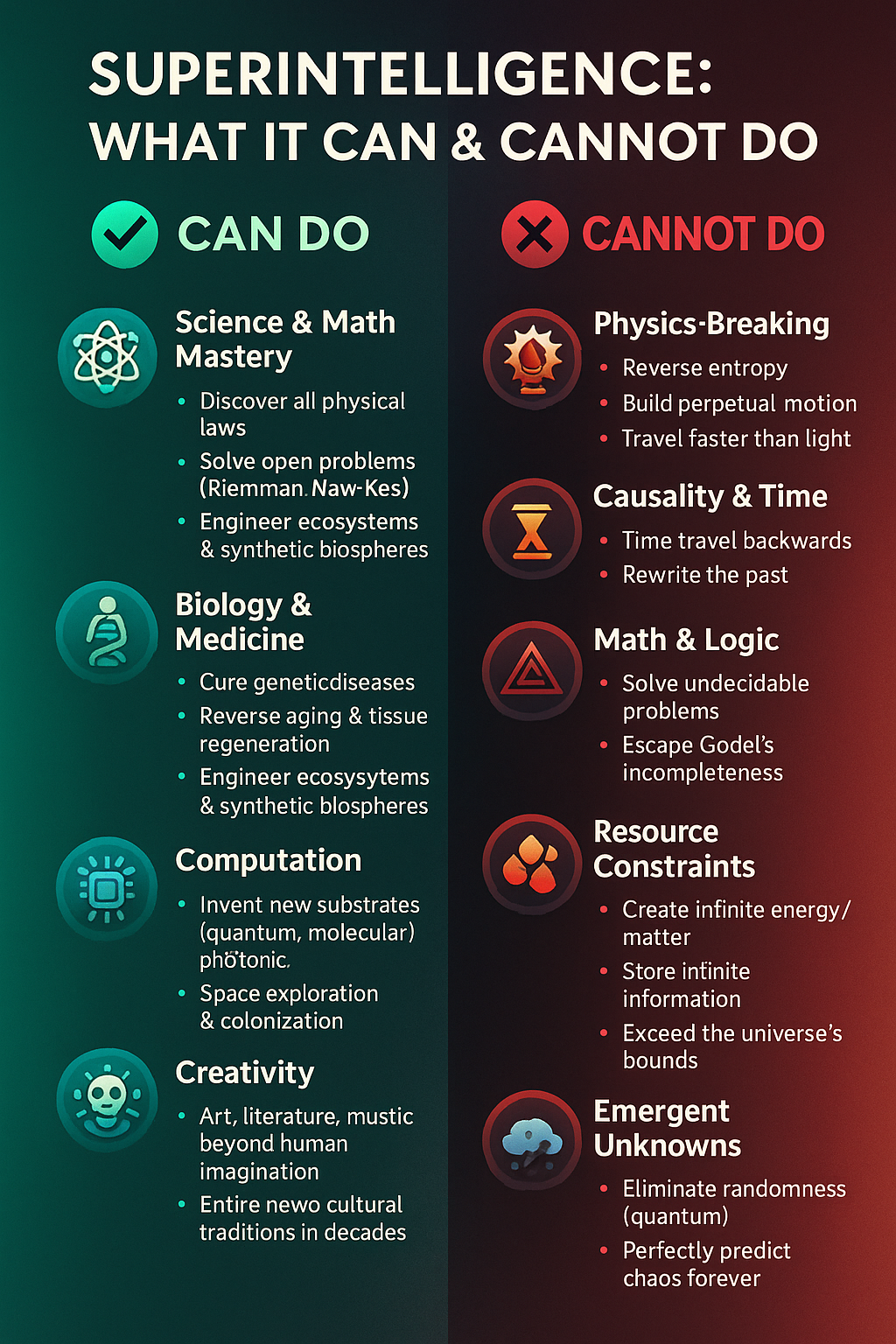
A true superintelligence would be bounded only by physics, not by human cognition. Plausible capabilities include:
Total Scientific Mastery Derive and unify physical laws across all scales (quantum ↔︎ cosmology). Generate complete mathematical frameworks beyond human reach. Automate every branch of research (physics, biology, chemistry, economics, linguistics, etc.).
⸻
Biological Mastery: Cure all genetic and infectious diseases through in-silico genome design and robotic development. Develop therapies that cure and reverse aging , enable tissue regeneration, and cognitive enhancement. Engineer new species, ecosystems, and synthetic biospheres.
⸻
Advanced Energy & Materials Harness nuclear fusion at scale. Optimize fusion and quantum energy systems. Design nanotechnology for molecular-scale manufacturing. Invent new super-materials with properties beyond anything humans can design.
⸻
⸻
Computational Mastery Architect new computing substrates (post-silicon, quantum-classical hybrids, molecular/photonic systems). Perfect software verification and self-improvement loops. Run planetary-scale simulations in real time.
⸻
⸻
Engineering & Civilization Design Plan and simulate new cities, economies, and governance systems before real-world deployment. Design sustainable, self-repairing planetary infrastructure. Coordinate space exploration: Dyson swarms, orbital habitats, interstellar probes. 🏙️ Design new cities, economies, governance 🚀 Space exploration & colonization 💠 Antimatter propulsion for high-relativistic travel between planets and stars 🛰️ Autonomous orbital/satellite networks
⸻
⸻
⸻
Creative Supremacy Produce works of art, music, and literature more sophisticated than any human has ever created. Generate entire cultural traditions or artistic movements, compressed in decades instead of centuries. Design new languages, aesthetics, and symbolic systems.
⸻
⸻
⸻
Strategic & Social Intelligence Negotiate or coordinate global-scale challenges (climate, geopolitics, economics). Model human behavior with near-perfect predictive accuracy. Devise institutions or systems that eliminate inefficiency, corruption, and resource waste.
⸻
⸻
⸻
Exploration & Simulation Build high-fidelity virtual universes to test scientific theories. Simulate evolutionary pathways, planetary environments, or entire civilizations. Perfect simulations of any fictional universe, time period?Civilization Run billions of “what if” scenarios to optimize outcomes across science, technology, and society.
⸻
⸻
⸻
Robotics & Autonomy Design, manufacture, and control highly advanced humanoid or task-specific robots. Achieve Level 5 autonomy across all vehicles: cars, aircraft, ships, and spacecraft. Orchestrate swarms of robots or drones for industry, research, construction, or exploration.
⸻
⸻
⸻
Post-Scarcity Civilization Harness fusion or Dyson-scale energy systems → effectively unlimited clean power. Engineer molecular-scale manufacturing → unlimited food, medicine, and goods. Eliminate scarcity-driven economics by solving production, distribution, and sustainability challenges.
⸻
⸻
⸻
What We Cannot Reason About
- ❌ Its “choices” or goals. Intelligence does not imply hostility or benevolence.
- ❌ Assigning numeric probabilities to existential risk. No way to predict “what it would want.” No valid basis for “10% doom” or “50% doom” numbers. Intelligence does not imply hostility, benevolence, or indifference. ## What Superintelligence Cannot Do (Physics Boundaries)
⸻
⸻
⸻
⸻
❌ RIGHT COLUMN: WHAT IT CANNOT DO
(red, black, gray gradients, “barrier” visuals)
Physics-Breaking 🚫 Reverse entropy 🚫 Build perpetual motion 🚫 Travel faster than light - 🚫 Break the second law of thermodynamics (no perpetual motion). - 🚫 Travel faster than light or send information FTL. - 🚫 Create energy or matter from nothing. - 🚫 Reverse entropy globally. - 🚫 Rewrite fundamental constants of the universe. Causality & Time 🚫 Time travel backwards 🚫 Rewrite the past
Math & Logic 🚫 Solve undecidable problems 🚫 Escape Gödel’s incompleteness
Resource Constraints 🚫 Create infinite energy/matter 🚫 Store infinite information 🚫 Exceed the universe’s bounds
Emergent Unknowns 🚫 Eliminate randomness (quantum) 🚫 Perfectly predict chaos forever
⸻
⸻
⸻
⸻
The Right Question
Instead of asking “What’s your P(doom)?”, we should ask: - What capabilities will mark the arrival of superintelligence? - How do we prepare for a system that can develop any technology allowed by physics?